Resume Proofing Checklist

Spelling Mistakes

Don’t use words with which you aren’t familiar.
Use a dictionary as you write.
Perform a spell check on your finished resume.
Carefully read every word in your resume. If you write “from” instead of “form,” your spell check will be unable to detect your mistake.
Have a friend or two proofread your resume for you.

Punctuation Mistakes

Check for periods at the end of all full sentences.
Be consistent in your use of punctuation.
Always put periods and commas within quotation marks (i.e., Won awards including the “John H. Malcom Memorial Service Award.”)
Avoid using exclamation points.

Grammatical Mistakes

Do not switch tenses within your resume - be sure they are consistent for each job you list. The duties you currently perform should be in present tense (i.e., write reports), but ones you may have performed at past jobs should be in past tense (i.e., wrote reports).
Capitalize all proper nouns.
When expressing numbers, write out all numbers between one and nine (i.e., one, five, seven), but use numerals for all numbers 10 and above (i.e., 10, 25, 108).
If you begin a sentence with a numeral, spell out that numeral (i.e., Eleven service awards won while employed.).
Make sure your date formats are consistent (i.e., 11/22/05 or November 22, 2008, or 11.22.08. Choose one and stick with it.).

Choose Your Words Carefully

Be on the lookout for the following easily confused words: accept (to receive), except (to exclude), all right (correct), alright (this is not a word), affect (to bring about change), effect (result), personal (private), personnel (staff members), role (a character assigned or a function), roll (to revolve).
Use action words (i.e., wrote reports, increased revenues, directed staff).

Other Potential Mistakes

Check dates of all prior employment.
Check your address and phone number - are they still current and correct?
Check the number of returns separating your categories: are they consistent?
Check abbreviation of state names. All state abbreviations are two letters - no periods. For example, New York is abbreviated NY, California is CA, and Florida is FL. Look up other state abbreviations.

Design Is Important

Don’t overcrowd your resume; allow for plenty of white space.
Keep your resume to one page whenever possible.
Keep the number of fonts you use to a minimum – two at the most.
Use a font that is easy to read. Do not justify the lines of type on your resume. Allow the right side of the page to “rag.”
Do not overuse capitalization, italics, underlines, or other emphasizing features.
Make sure your name, address,phone number and email address appear on your resume and all correspondence, preferably at the top of the page.
Print your resume on white or cream paper using a good-quality printer. Print on one side of the paper only.

What To Omit

Omit salary history.
Omit sex, age, race, marital status, or other similar personal information.

Share Comments

Kernighan's law

“Debugging is twice as hard as writing the code in the first place. Therefore, if you write the code as cleverly as possible, you are, by definition, not smart enough to debug it.”

Share Comments

Find Out If an Interview Is Going Well by Asking the Interviewer About His or Her Job

Other than reading your interviewer’s body language or coming right out and asking if he or she thinks you’re fit for the job, one simple question may be all you need to gauge how an interview is going or went: “Why do you work here?”

Steve Browne, an HR director, says on HR Bartender that the way the person answers can be a sign that the interview went well (or not):

I recommend that people ask “Why do you work here?” as their first follow-up question every time. When they do this, the interviewer will inevitably let their guard down and the candidate can judge how the person answers. If they seem to relax and engage the candidate, the interview went well. If they are aloof and give the Company “line” as a response, then it may have not gone well.

Share Comments

Use the “Layoff Test” to Build Your Professional Network

Your professional network may be just as valuable a job hunting tool as your resume, but if you haven’t kept it up to date and you’re not in touch with the people you’re closest to, now’s the time to reach out. Use the “Layoff Test” to beef up your professional network and strengthen those bonds now, when you don’t need anything from them but their friendship.

Here’s the test: If you were laid off today, who would be the first ten people you’d reach out to for advice, or to catch up with? When is the last time you spoke with them? If you can’t even list ten people, much less remember the last time you caught up with some of the people you would normally call references, it’s time to start reaching out now, while you’re comfortably employed and don’t need anything in particular.

Ask them out to lunch to catch up, or see if they can grab coffee with you sometime, just to see how they’re doing, discuss your respective careers, and see if they need anything from you. Remember, a “professional network” is really just career code for “friends willing to help each other professionally,” so stay in touch and see if you can lend them a hand as well. After all, what goes around comes around.

LifeHacker

Share Comments

Use the DASH Method to Become a Better Writer, Developer, Or Tackle Any Other Creative Task

The DASH Method (short for Direction, Acceleration, Strength, and Health) was designed to help people who write—whether it’s technical writing, novelists, or bloggers—get things done faster and better, but the principles can be applied to almost any type of creative work. The end result is that you work smarter, and come away feeling better about what you do.

Direction

Direction implies that you always start work with your end-goal in mind and a plan for how you’ll get there.

Acceleration

Acceleration encourages you to remember that getting started is everything, and to keep working until you’re finished. Don’t get hung up on details, after all done is better than perfect.

Strength

Strength is less about training, but about bolstering your mental and physical strength by building the right environment for you to work, whether it’s a quiet space with no distractions or a buzzing space that makes you feel inspired.

Health

Finally, Health reminds you to take care of yourself, take breaks, and keep brainstorming so your creative juices are flowing.

All in all, the core tenets are things that ideally you work into your work routine already, but assembling them together into a package like this one may be just the reminder you need to apply them to every aspect of your work, whether you write for a living or not. Hit the link below for a much broader description of each point, along with some additional tips.

Share Comments

UML distilled - Martin Folwer

Martin Folwer Publication Date: September 25, 2003 | ISBN-10: 0321193687 | ISBN-13: 978-0321193681 | Edition: 3

Timeless: Reduce everything to its essence so that form harmonizes with function.

Overall

Graphical design notations have been with us for a while. For me, their primary value is in communication and understanding. A good diagram can often help communicate ideas about a design, particularly when you want to avoid a lot of details. Diagrams can also help you understand either a software system or a business process

Many people believe that in the future, graphical techniques will play a dominant role in software development.

The Unified Modeling Language (UML) is a family of graphical notations, backed by single meta-model, that help in describing and designing software systems, particularly software systems built using the object-oriented (OO) style.

The fundamental driver behind them all is that programming languages are not at a high enough level of abstraction to facilitate discussions about design.

The essence of sketching is selectivity.

(UML as blueprint is about completeness) In forward engineering, the idea is that blueprints are developed by a designer whose job is to build a detailed design for a programmer to code up. However, the creators of the UML see the diagrams as secondary; the essence of the UML is the meta-model. Diagrams are simply a presentation of the meta-model.

The UML, in its current state, defines a notation and a meta-model. The notation is the graphical stuff you see in models; it is the graphical syntax of the modeling language.

A language with prescriptive rules is controlled by an official body that states what is or isn’t legal in the language and what meaning you give to utterances in that language. A language with descriptive rules is one in which you understand its rules by looking at how people use the language in practice.

My attitude is that, for most people, the UML has descriptive rules.

The waterfall style breaks down a project based on activity. To build software, you have to do certain activities: requirements analysis, design, coding, and testing.

The iterative style breaks down a project by subsets of functionality. You might take a year and break it into 3-month iterations.

You may well not put the system into production at the end of each iteration, but the system should be of production quality.

Most writers on software process in the past few years, especially in the object-oriented community, dislike the waterfall approach. Of the many reasons for this, the most fundamental is that it’s very difficult to tell whether the project is truly on track with a waterfall process.

A common technique with iterations is to use time boxing. This forces an iteration to be a fixed length of time. A good rule of thumb is that the size of your unit test code should be about the same size as your production code.

Agile is an umbrella term that covers many processes that share a common set of values and principles as defined by the Manifesto of Agile Software Development (http://agileManifesto.org)

In terms of our discussion, agile processes are strongly adaptive in their nature. They are also very much people-oriented processes.

Agile processes tend to be low in ceremony. A high-ceremony, or heavyweight, process has a lot of documents and control points during the project.

Whether or not you use a waterfall approach, you still do the activities of analysis, design, coding, and testing.

Use cases describe how people interact with the system.

An activity diagram, which can show the work flow of the organization, showing how software and human activities interact.

• Class diagrams from a software perspective. These show the classes in the software and how they interrelate.
• Sequence diagrams for common scenarios. A valuable approach is to pick the most important and interesting scenarios from the use cases and use CRC cards or sequence diagrams to figure out what happens in the software.
• Package diagrams to show the large-scale organization of the software.
• State diagrams for classes with complex life histories.
• Deployment diagrams to show the physical layout of the software.

One of my concerns with blueprints is my own observation that it’s very hard to get them right, even for a good designer.

I believe that detailed documentation should be generated from the code—like, for instance, JavaDoc. You should write additional documentation to highlight important concepts.

The class diagram should be supported by a handful of interaction diagrams that show the most important interactions in the system.

A class diagram describes the types of objects in the system and the various kinds of static relationships that exist among them.

The multiplicity of a property is an indication of how many objects may fill the property.

An important principle of using inheritance effectively is substitutability. I should be able to substitute a Corporate Customer within any code that requires a Customer, and everything should work fine.

Interaction diagrams describe how groups of objects collaborate in some behavior.

Despite this, object bigots like me strongly prefer distributed control. One of the main goals of good design is to localize the effects of change. Data and behavior that accesses that data often change together. So putting the data and the behavior that uses it together in one place is the first rule of object-oriented design.

If a caller sends a synchronous message, it must wait until the message is done, such as invoking a subroutine. If a caller sends an asynchronous message, it can continue processing and doesn’t have to wait for a response.

If you find that you need a modeling construct that isn’t in the UML but is similar to something that is, use the symbol of the existing UML construct but mark it with a keyword to show that you have something different.

A UML interface is a class that has only public operations, with no method bodies

Classification refers to the relationship between an object and its type.

The UML uses the generalization symbol to show generalization. If you need to show classification, use a dependency with the «instantiate» keyword.

Generalization sets are by default disjoint: Any instance of the supertype may be an instance of only one of the subtypes within that set.

Association classes allow you to add attributes, operations, and other features to associations.

Aggregation is the part-of relationship. It’s like saying that a car has an engine and wheels as its parts.

The general rule is that, although a class may be a component of many other classes, any instance must be a component of only one owner. The “no sharing” rule is the key to composition.

An abstract class is a class that cannot be directly instantiated.

A qualified association is the UML equivalent of a programming concept variously known as associative arrays, maps, hashes, and dictionaries.

An object diagram is a snapshot of the objects in a system at a point in time.

A package is a grouping construct that allows you to take any construct in the UML and group its elements together into higher-level units.

Artifacts, which are the physical manifestations of software: usually, files.

Use cases are a technique for capturing the functional requirements of a system. Use cases work by describing the typical interactions between the users of a system and the system itself, providing a narrative of how a system is used.

A scenario is a sequence of steps describing an interaction between a user and a system.

A use case is a set of scenarios tied together by a common user goal.

As well as the steps in the scenarios, you can add some other common information to a use case.
• A pre-condition describes what the system should ensure is true before the system allows the use case to begin. This is useful for telling the programmers what conditions they don’t have to check for in their code.
• A guarantee describes what the system will ensure at the end of the use case. Success guarantees hold after a successful scenario; minimal guarantees hold after any scenario.
• A trigger specifies the event that gets the use case started.

State machine diagrams are a familiar technique to describe the behavior of a system

The transition indicates a movement from one state to another.

Activity state: The ongoing activity is marked with the do/; hence the term do-activity.

The activity diagram allows whoever is doing the process to choose the order in which to do things.

UML 2 uses the terms flow and edge synonymously to describe the connections between two actions.

Interaction overview diagrams are a grafting together of activity diagrams and sequence diagrams.

Share Comments

Parameter passing in Java - by reference or by value?

Myth: “Objects are passed by reference, primitives are passed by value”

Some proponents of this then say, “Ah, except for immutable objects which are passed by value [etc]” which introduces loads of rules without really tackling how Java works. Fortunately the truth is much simpler:

Truth #1: Everything in Java is passed by value. Objects, however, are never passed at all.

That needs some explanation - after all, if we can’t pass objects, how can we do any work? The answer is that we pass references to objects. That sounds like it’s getting dangerously close to the myth, until you look at truth #2:

Truth #2: The values of variables are always primitives or references, never objects.

This is probably the single most important point in learning Java properly.
It’s amazing how far you can actually get without knowing it, in fact - but vast numbers of things suddenly make sense when you grasp it.

Why is all this important?

When people hear the words “pass by reference”, they may understand different things by the words. There are some pretty specific definitions of what it should mean, however. Dale King sometimes quotes this one: “The lvalue of the formal parameter is set to the lvalue of the actual parameter.” (Dale’s formal analysis of this whole question can be found at the bottom of this page.) This would mean that if you wrote the following code:

1
2
3
4
5
6
7
Object x = null;
giveMeAString(x);
System.out.println(x);

void giveMeAString(Object y) {
y = "This is a string";
}

the result (if Java used pass-by-reference semantics) would be

1
This is a string

instead of the actual result:

1
null

Explaining the two truths above eliminates all of this confusion.

So what does passing a reference by value actually mean?

It means you can think of references how you think of primitives, to a large extent.

For instance, the equivalent to the above bit of code using primitives would be:

1
2
3
4
5
6
7
int x = 0;
giveMeATen(x);
System.out.println(x);

void giveMeATen (int y) {
y = 10;
}

The balloon analogy

I imagine every object as a helium balloon, every reference as a piece of string, and every variable as something which can hold onto a piece of string.

If the reference is a null reference, that’s like having a piece of string without anything attached to the end. If it’s a reference to a genuine object, it’s a piece of string tied onto the balloon representing that object. When a reference is copied (either for variable assignment or as part of a method call) it’s as if another piece of string is created attached to whatever the first piece of string is attached to. The actual piece of string the variable (if any) is holding onto doesn’t go anywhere - it’s only copied.

This analogy also explains garbage collection (apart from the java.lang.ref API, which does “odd” things :) - a balloon floats away unless it is tethered down to something. The balloons can have further holders on them (instance variables), but just because two balloons are holding onto each other doesn’t stop them from floating away. (Cyclic references are collected.) Any balloon representing an object which is in the middle of having a method invoked is tethered to the JVM. (Apologies for not being able to phrase that more succinctly - all I mean is that anything in an active thread’s stack isn’t garbage collected.)

Share Comments

Is It Time for You to Stop Dabbling and Get Serious?

December 11th, 2012 by Steve Pavlina

http://www.stevepavlina.com/blog/2012/12/is-it-time-for-you-to-stop-dabbling-and-get-serious/

If you want to start on a serious career path, don’t even think about giving up during the first year. Very little happens during the first year in terms of results. Most businesses aren’t even profitable in their first 2 years; it takes them that long just to become sustainable, even for fairly small businesses.

So many would-be pro bloggers give up in their first 6 months. They get bored, lose interest, or get a “better” idea for some other venture. I see them change topics or URLs and start over once or twice a year. After five years of this kind of dabbling, they’ve still barely gotten anywhere. They keep erasing what little progress they’ve made, so they never have the chance to develop anything serious and enduring.

When it comes to building any sort of business, either online or offline, this dabbling approach is a bit ridiculous because the real payoff from business comes from consistency over a period of years. It takes time to build a following, attract customers, develop products and services, gain links and search engine placement, generate referrals, develop good business sense, acquire expertise, and figure out how to generate income from your work in ways that feel congruent to you.

It took 25 months from when I started blogging to pass $10K/month in income from it, which happened in 2006. In the first 6 months, however, my blog only made $167 total, mostly from Amazon’s affiliate program. If I gave up during that time and started over, I’d never have enjoyed the long-term benefits of this path. Most professional bloggers, however, give up well before they reach this point. They see weak financial results during their first year just as I did, but they conclude it’s not worth continuing if they haven’t made it sustainable by then.

In addition to earning abundant income from blogging (mostly from affiliate and joint-venture deals these days), blogging has also created opportunities in other areas, like speaking (I have talks coming up in Las Vegas, Rio, Germany, and Washington DC), getting a book published (ongoing royalties), coaching (started at $997 per coaching call, now at $4997 per call), free travel, amazing social connections, etc.

If you want to generate serious income and enjoy an abundant lifestyle, it’s crucial to get past the dabbling phase. For starters the incessant dabblers are perpetually broke. They keep giving up and changing their minds well before they’d otherwise begin reaping the long-term benefits of sustainability and growth. Before they even have a chance to experience serious results, they pull the plug.

The truth is that you can generate serious income from just about any form of creative work — writing, audio, video, art, music, programming, design, etc. Others who came before you have already made millions from these paths. But most of them didn’t get very far in their first 6-12 months. It’s the ones who stuck with it for 5+ years that are reaping the biggest benefits. They’re builders, not dabblers.

A pattern I’ve noticed in my most successful friends in business is that at some point they made the decision to get serious about their work. They decided to stop dabbling, stop drifting, and stop coasting. They committed to a particular path and doubled down on it, intending to stick with it for years so they could really master it. Consequently, those same people are enjoying serious results. Meanwhile, the dabblers are still looking for that next Get Rich Quick idea that can grant similar results within a matter of months.

If you ask your friends what kind of work you’ll be doing 5 years from now, what will they say? If you’re not sure, go ask some of them. If they give you answers you don’t like, or if their answers are inconsistent, why is that? Are you broadcasting that you’re a dabbler? Do you have a history of dabbling? Are you being wishy washy and noncommittal? If you think you’re committed, but the people around you don’t perceive that commitment, you’re probably not committed.

If you’re on a strong and successful path, the people in your life will likely be able to predict what field you’ll be in 5 years from now. It will be the field you’re committed to right now.

If you want to build up some abundant income streams and enjoy the long-term benefits of stick-to-itiveness, pick an interest that you expect you’ll still be passionate about 5 years from now. I picked personal growth since I’d already been passionate about this field for more than a decade before I started blogging, so I had good cause to believe I’d still be into it 5 years later. It’s now 8+ years since I started blogging, and I’m still passionate about personal growth. I still love the work I do and have no desire to quit and switch to something else. The specific details of my interests change from year to year, but my core passion remains largely the same. If I’d made a less conscious choice or more impulsive choice 8 years ago, I might very well have dumped it within the first year.

Don’t overplay today’s fleeting interests when you think about making a serious commitment to a career path. Look instead to the interests you had 5 years ago that you’re still seriously interested in today. Chances are you’ll still be maintaining those interests 5 years from now. If you’re going to have these interests anyway, why not bet bigger on them and commit yourself to mastery?

Doing something for a long time isn’t the same thing as committing to mastery. I’ve been into disc golf for about as long as I’ve been into personal growth (20+ years), but I never committed to improving disc golf. I never got serious about it. Even though I play disc golf most weekends with friends, I’m probably no better at it than I was 5 years ago. My skills hit a plateau, and I’ve stayed there for years. For me disc golf is a hobby I enjoy for fun, and I haven’t cared to improve at it thus far.

If you’re okay being no better off in your career 5 years from now, then there’s no need to commit to mastery. Keep dabbling, or keep doing what you’re doing without making a serious commitment. But if it’s not very palatable to you to stagnate, or if you desire much stronger results 5 years from now, then it’s time to think about getting serious.

If you want to dabble for the sake of exploration, that’s fine. But don’t pretend you’ve chosen a career path. You’ll only look foolish when every 6 months you’re telling your friends that your career path has changed yet again. Know that you’re exploring, and do it to learn. Then when you’re ready to get serious, commit to building something that endures, and don’t even think about quitting during the first year.

Rule of thumb: If you can’t make a serious 5-year commitment to a given career path, it’s not your path.

Share Comments

How To Get an Energy Boost Without Caffeine

Between work, classes, and socializing, life can get pretty hectic. In response, we often rely on caffeinated drinks to keep us going. Sure, everyone knows that caffeine can give you a much-needed jolt, but at what cost? It can also cause headaches, breakouts, and mood swings, just to name a few negative side effects. The good news: there are better, healthier ways to get energy without all that caffeine clogging your system.

Have a Protein-Filled Snack

Feeling drowsy? Nosh on a protein-packed snack. This is a simple but effective way to keep yourself going throughout the day. Think crunchy apple slices with creamy peanut butter, turkey roll-ups with string cheese, or almonds and dried fruit. If you’re crunched for time, pick up a smoothie with a protein boost—most places offer free “boosts.” Jamba Juice has a great energy one that has B vitamins in it to help physical and mental stamina. Bonus: it helps your metabolism too!

Pop a B Vitamin

Vitamin B deficiency has been linked to low energy levels, among other things. In fact, mood changes, poor concentration, anxiety, and depression can all be signs of a vitamin B deficiency. So if you’re feeling tired regularly, try popping a B-complex vitamin. Most grocers and health food stores carry a variety of brands that you can choose from. Another option is to take a multivitamin, which will help ensure that you’re not deficient in other minerals or nutrients. For the best results, take your multivitamin during a meal—preferably breakfast. According to NutriHealth, the nutrients are better absorbed when mixed with the healthy fat in your food.

Try a Quick Workout

When you’re tired, hitting the gym is the last thing you want to do. But studies show that a short sweat session can kick up your energy levels for the rest of the day. According to Fitness Magazine, you don’t need to pound the treadmill for an hour—a quick jog around the block will do. Feeling unmotivated? Pop in some headphones, cue up your favorite upbeat tunes, and hit the pavement! If you want to stay in your room, a quick set of 25 jumping jacks can help give you a boost.

Take A Cold Shower

Hot showers are the best for relaxing and winding down. But if your goal is to do the opposite, consider changing the temperature. Cold water stimulates your system and speeds up circulation, resulting in a more alert you. Don’t want to give up the soothing heat completely? Try taking a regular shower, then cooling it down for the last 5 minutes or so. It’ll still do wonders for your mental awareness. Really not into the cold shower thing? Splash cold water on your face for a midday refresher.

Eat Smaller, More Frequent Meals

According to Terri Fant-Franklin, a nutritionist at Kaiser Permanente, changing your eating habits can greatly increase your energy levels. “Having smaller, more frequent meals will keep your calorie flow at a more even pace which helps with energy,” Fant-Franklin says. Heavy meals often leave us feeling drowsy, while smaller portions can have the opposite effect. Try to avoid sugary drinks, which are often loaded with caffeine and additives. Chances are, you’ll end up crashing later.

Go To Sleep 20 Minutes Earlier

It’s easy to procrastinate during the day and put off projects until the wee hours of the night. But this pushes your bedtime back later and later. Before you know it, you wake up on four hours’ worth of sleep, tired and cranky. Let’s just say that this situation is less than ideal. But there’s a simple and effective way to change your habits. Instead of being unrealistic and wishing you could sleep through that 7AM alarm, take action the night before. Aim to hit the sack 20-30 minutes earlier and chances are, you’ll end up getting significantly more sleep.

Take a Walk

Taking a brisk stroll has similar effects to working out. According to WebMD, moving your body (even at a slow pace) will have you feeling more alert in just minutes. Since the weather has cooled down, the chilly winter air will also help wake up your senses. Worried you’ll get bored? Grab your camera and snap photos of the beautiful fall foliage you see along the way. You can also incorporate this tip into your daily routine by walking instead of taking the bus or driving. Bonus: a leisurely walk is great for clearing up brain fog, which can result from hours spent at a desk or too much computer time. So next time you need a break from doing work or studying, head outside.

Get A (Reflexology) Massage

In the practice of reflexology, your hands and feet are filled with pressure points that relate to specific areas of the body. For example, the top part of your thumbs correlates with your pituitary gland. Massages generally leave you feeling refreshed and rejuvenated, but reflexology takes things one step further and pinpoints specific areas that need work. According to The American Reflexology Certification Board, the practice helps restore balance to the body. Try making an appointment with a specialist or give yourself a quick massage (or recruit a friend to) for a DIY midday pick-me-up. Apply pressure to the different areas on your hands and feet, alternating to stimulate multiple organs. It’ll double as a mental break, preparing you for the rest of your busy day!

Talk It Out

Next time you’re feeling down and tired, try talking to a friend. Studies show that chatting can help make you feel more alert. Being socially disconnected can trickle into other areas of your life, resulting in negative thoughts and lower levels of productivity. Catching up on gossip will pique your interest and keep you going. Friends too busy to talk? Calling someone works too. Dial your mom’s cell and catch up on the latest family news.

Meditate

The mind is a powerful tool. It’s been proven that visualization exercises can help bring you closer to achieving your goals. A recent Miller-McCune article discusses the many benefits of meditation. Next time you’re feeling zapped for energy, try this simple exercise: sit on a chair with your back straight and your hands on your knees. Close your eyes and envision yourself feeling positive and energized. Take deep breaths and keep your posture strong. Before long, you’ll have an increased sense of mental and physical awareness.

10 Ways To Get Energy Without Caffeine | Her Campus

Share Comments

Inspiration Is Like Food Poisoning

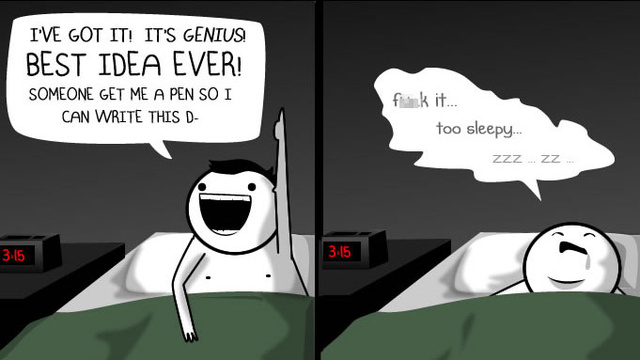
“Inspiration isn’t something you can schedule, harness, or control. Inspiration is more like food poisoning: it sprays out uncontrollablly when you need it the least.” - The Oatmeal

That’s why we sleep with notebooks by our beds, after all. We often think best when we’re not trying to think, like while dreaming or standing in the shower. But that’s kind of what makes inspiration great: it’s a surprise.

Share Comments